
On this page
-
Departments (1)
-
Text (10)
-

Untitled Article
-

Untitled Article
-

Untitled Article
-
Untitled Article
-

Untitled Article
-

Untitled Article
-

Untitled Article
-

Untitled Article
-

Untitled Article
-

Emmvial H&avli&uwt
Note: This text has been automatically extracted via Optical Character Recognition (OCR) software. The text has not been manually corrected and should not be relied on to be an accurate representation of the item.
-
-
Transcript
-
Note: This text has been automatically extracted via Optical Character Recognition (OCR) software. The text has not been manually corrected and should not be relied on to be an accurate representation of the item.
Additionally, when viewing full transcripts, extracted text may not be in the same order as the original document.
Untitled Article
DISTRESS . TO THE JEDITOB OP THE IfOBTHEEN STAB . giB , —A great deal has been said of late respecting the distress that . prevails throughout this country , and the cause of it . The Whigs contend that it is in consequence of tie Gam iaws being in operation , and gat if these laws were repealed , we should enjoy happiness and prosperity without interrnptian . This is all Tery plausible indeed , but I very much doubt it The £ u > t is , £ ne people bave been duped so repeatedly with axe Whigs , vbUe they were in office , that it would be madness in the extreme , to expect anything really good from any measnre thzt they may propose ,- either in or out cf Parliament
I admit , Sir , tfcai there Is great distress , not only in jTsucbester , but io almost eTeiy pail if the conn try , £ . nt it is absurd to assert that a total repeal of the Com Laws would remedy the eviL If the Ck > rn laws had been repealed twtEty-Sve years ago , it most certainly wonid tare been a great relief to this country , but that is not the real cause . I am decidedly tf opinion , Sir , that improvements in machinery and competition are the principal causes ef a great portion cf the distress teat now exist in Manchester and the manufacturing districts ceneraily .
I have been employed in the cotton business upwards of twentr-slx yeara , during -which period I have seen considerably bitter days . In the year 1 S 29 , there were o ^ DD operative cott « n spinners in Manchester and Salford alone , each spinner workiug a pair of mules averaging fcboni SOS spindles each . In the year above caintd , it was agreed unto , by tha fire master spinners as » body , that if any of them had mules exceeding 300 spindles , they would be allowed to pay to the operatives , in tL . e shape of wages , at the rate of one and a
half per cent lass Iot every twelve spindles sbove 300 ; so that those masters that had mules of 600 spindles each , would derive an extra profit of thirty-seven and a half per cert , over those masters that had mules cf 300 spindles . This being the case , the mindfi of the masters trere constantly agitated in scheming" and contriving how to excel each other in lengthening their Knles : acd these improvements have extended to such 63 amazing degree , that at the present time the operatives are compelled to work a pair of mules of 1000 to 1344 spindles each .
But tins is not all : —In coarse spinning there are an frnfnPTiap quantity of self-acting mules that supersede TpynTmi Jabonr entirely ; and these are extending v ^ ry rapidly , so that at the present period there are only about 700 operative cotton spinners in Manchester and Sslford ; the remainder 1700 are cast adrift , "wandering about the streets in ssarch of employment , but in vain , in a state of wretchedness and misEry too awful to contemplate-Improvements in other machines connected with the preparing cf the cotton are also extending very rapidly , improvements that are calculated to diminish the number of workers te a fearful extent ; and in fact , an immense number ef yonng persons from fourteen to eighteen years of age are already sacrificed . But these improvements are not confined to Manchester only , no ; tbey extend to ererj spinning district throughout the United Kingdom . What I have stated above are indisputable f-tets .
Now , I ask tfee anti-Corn Law league , will a repeal of the Corn laws give employment to the 1700 opera tive cotton spinners , besides other hands , that have been sacrificed in Manchester and Salford alone , in consequence ef improvements in machinery ? or will a repeal of those laws restore to them their-wonted occupation ? Any man that is possessed of common sense J will answer no . Again , there are hundreds of our fellow-eountrymen in other trades that are suffering from the same causes . Mechanics for instance , in -mr , chine shops we find selfacting sliae-laiths , self-acting dotting-machines ,
selfacting baring-machines , » nd self-actmgplaining machines that perform as much work in one day as fifty man . We have machines for sawing timber by power . Engraving is done in part by machinery j and in the " Mechanics * Magazine , " I read of an Iron Mason—a machine under this name ( for which a patent has just been taken out ) is about to be erected in a stone quarry at Woodside , Glasgow . Tfee stones go into tae machine rough as they come out tf the qaarry , and come out polished Ashlar on the surface , and cut paralleled and squared on the sides , folly ready for tke builder , and this at an expence of not more than a quarter of the work done by hud .
The present machine is calculated to do the work of two hundred and fifty men , reckoning only six hours ' work oui of ten . . - There aiB numerous other trades that might 09 " ttfffiaced , if space wi old admit , where roym ^ labour is superseded by machinery . This being the case , it is no wonder that our countrymen are distressed ; how can it be otherwise , when the population is increasing and employment continually decreasing ? It is not my intention to say anything either for or against these improvements , my object is simply to give the people to understand , that if they expect a repeal of the Com laws to gjve them that mceoui and protection they require , they will , under these circums&nces , be most bitterly disappointed .
v « 3 y probably , some of the repealers will be ready to say , bntif foreign corn was allowed to be brought into this etrantay free of duty , foreigners woulfi exchange their corn for our manufactures , and thereby cause a greater rtermtnrt for labour . If tbe Corn laws had been repealed twenty-five years ago , as J said before , it Tery liifely would have been the case ta a greater extent j but it unfortunately happens that Old England has to compete xow with a formidable host of manufacturing rivals from Germany , France , Switzerland , and Belgium , and indeed almost every nation cf the continent of Europe , they having raised tip at great sacrifice ol national wealth a manufacturing industry for themselves , and compete with us is many parts of the world .
We are also almost excluded from the German market , and Austria has sealed her territory against on ? merchandize . Again , only reflect for a moment of the vast portion of our mechanics and labourers that Lave already and ars rtill leaving our shores , and are emigrating to different parts of the world , and as a matter of couxst , the skill , genius , and industry of tur beloved country are transmitted to foreigners , an event which i appre&end , will prove an everlasting djfiad-Y&Etage Id this eonniry . Seeing , then , that the mannfactore of cotton in all its branches has arrived to such a state of perfection , not only on tie continent of Europe , but in America ; and considering the privations that our conntrymsn have to endure , in consequence of improvements in machinery I am decidedly of opinion that a repeal of the Corn Laws alone , is quite inadequate to give to this couafay that protection which tee promoters of the scheme so vainly anticipate . A LOTEE OF SIT COOTHT . Manchester , April 1 st , 18 i 2 .
Untitled Article
10 THE PEOPLE OF IRELAND . TELL 0 "W CorXTETMBN , —In my letter of the 12 th nit . I utt before you ths corruptions and reckless tyranny practised by the minions of a state church , and I hope proved to your satisfaction that Christianity does not sanction deeds of oppression , I will now taie np the sane subject and examine how far Mother Church Reserves the rapport of the people , and what return she mates , and what service she renders to religion for the ten millions per annum which she drswB from the vitals of tha poor—ten mlBioEB sterling . ' . ' yes , tin million ponnds worth of the sweat and blood , the sorrows and sufftrings of the toil-worn and famishing poor!—ten millions pounds worth of the tears and anguish of the widow and tbe fatherless , given for the support of a pampered , bloated hierarchy for the pretended advancement of religion and the propagation of Christian charity 1 Oh . what a blasphemcns assertion
to say that Christianity requires a princely income to rapport its principles , -when lie who laid the corner-stone of the edifice was the poorest of the poor and preached the doctrines of poverty and Belf-denial J Think of a State Ctrnrch , calling herself the Church of Christ , requiring ten millions annually to support her dignity , aid ef the Son of God begging his bread and command ing his discpies to " take neither scrip nor staff ! or be solietons for the wants of to-morrow ! " Think of the disciples telling all they had and giving t « the poor , and of the Bishops of our State Church grasping with insatiable avarice tha enormous sum of ten millions from the pockets of an oppressed and starving people ! Ten millions , wrung from the expiring victims of tyranny sad misrulei And for what ? Answer . me , them old hypocrite . What do you give in return for Such aa enormous sum ? What do yonr Bishops , who boast of their immediate descent from Christ and the
. Ap' -sties do in return for tbe people who support them in tSuence and luxury ? Do tbey , like the men whom tbey falsely represent , labour in their calling , and with meekness and perseverance endeavour to extend that Chisuan charity which their Divine Master suffered an ignominious death to establish ? Tell - me , do they , in a word , act u becomes their office , or are they worthy tbe name ef Christians ? No . And why ? Because the " State Ghnxeh" of these kingdoms is based iipon & rotten sad corrupt foundation , and bean no similitude whatever to toe " Cbnrcn of Christ and hi » AposUea . " Tbey worked hard to establish Christianity &nd suffered tbe most intense privation ; but the Apostles of onr " State Church" have , it would appear , io necessity to work . They have a religion " Cut and T dry , " and ready to their hands , with funds to * npport ' s , -withont doing the drudgery of making converts .
What a precious wmBtxy i * is * "where the people are £ &nring and compelled to support and feed a swarm of leasts , which in Ttpgi * t > il and Wales al » ne , { without Sectioning tbe Irish establishment ) number about 15 , 000 ! Yes , one of tbe blessed fruits which tie peofcreap from tfrtf ? generous support , is the gratifying * &i unspeakable pleasure of looking at tbe smoothed , sleek and fat parsons , -woo eat up everything « * the glory of God ) , bxrt who never produce anything ^ imigtry and distress . 1 know the Irish , have a great fancy for rnch per-J * » ets . { ¦>) Oh ! yea , they love them and they ought ; (?) they have to support only tweniy-two Bishops , >« l their own clergy are obliged to subsist upon 2 * st , and themselves ^ n ^ qriTig the most unheard-of *^* aona . ¦ J ^ onia && &e people of Great Britain and Ireland Z ** they receive in retera for their ten millions ^ * By ) which mother -chxxch ao tmscwpnlousiy
Untitled Article
demands for her Bubsistemie ? What , I ask , do the people receive ? Every thing But gratitude ! Tae Dissenters are frowned upon because they have the moral courage to declaim against so great an irjustice ; and the Catholics are hated because they are tenacious of the faith of their ancestors . What sympathy have the Bishops for the soula of the people , or what care the parsons , so long as they can feast upon the " milk and honey" of the land , at their expense ? How can men who are part and parcel and the very won * class uf tbe aristocracy , fsel an interest in tducating the people , and teaching them to be wise and moral ; when they alreaay know that the ignorance of the nation is the great cause of their power , and that such wisdom , would be the means of their own destruction ? Or -what cares the lazy , luxurious Bishop , " or the swearing , drinking , fjx-hunting parson , who possess Irish ivings , but who seldom set their eyes on their flock , or the country where they exiBt ; about the spiritual instruction of the poor .
Talk of educating the people ! oh yea ; they will give youthe paltry sum of £ 30 , 000 , but tbey will give her Majesty ' s horses £ 70 . 000 , because I suppose they are of more conseqnenee to the state than you , whe find the money , not only to feed but purchase them . The people of Ireland have many serious causes of complaint against the present system of church establishment ; nine-tenths of them are Catholics and Dissenters , who . never enter a church deor , and yet they are comptlled to pay the parson , although he ( Door charitable disciple ) denounces tha very men who support him , and swears they are idolaters , and deserve to b « d—d . This is the oath mother chnrcb . requires hsr apostles to subscribe to before they are considered qualified to demand yonr money , and plunder you of the scast . residue of ill-requited lat > our . What a mockery -of Christian charity , to consign you to eternal torments , and at the same time hasten your departure : o those regions by helping to starve yon out of existence ; *
I have admired the charity of ths Redeemer , who , poor as he was , not only administered relief to those who needeiMt , bnt stretched out his hand and raised the dead from the tomb to show bis love to his creatures ,- and as an tximple of benevolence to be imitated by his disciples . Yes , he fed the mnltitnde ana raised the widoWa son . He did not send the people away hungry , nor did he reqnlre tbe disconsolate mother to swear she would pay him for his services for raising her son from the grave , Oh , no ! But the parson of a state church has often witnessed the agonising misery of famishing humanity and turned tbe claimant from his door ; he has taken the life of the widow ' s son , and has presented the sacred volume in which Christian charity is written by the finger of a merciful Gred , t j the lips of a wretched mother that she might swear she would pay h ' ^ m his tithes as a recompense for" the bloody deed he had committed .
I have vntnesssd the -unholy pillage , and shuddered to behold the smoke and flames of yonr solitary stack , rising as if to heaven for vengeance ; and I have been confounded at the fact , that the band which committed ihe viie act , waa that which claims to be the dispenser of Christian charity . Tea , mother church is the incendiary , and as such she deserves to be arraigned by the people . The poor man who in a moment of desperation fires , or attempts to fee his neighbour ' s cottage , or barn , is convicted as & felon , and suffers banishment or death for his offence ; bnt the consecrated highwayman who Ifor the glory of God )
and from whence the bishops and parsons derive the authority to trample on the civil and religious liberties of the people ? 1 deny that &od ever dictated such a doctrine , or that Christianity sanctions deeds of oppression . I do Hot believe that religion requires such an unholy aid , and I fearlessly state , heaven dees not approve of it . Whence then have they obtained this power ? Is it from man ? Yes . Well then , I argue , as they thus act under the preUnce of promoting the interests of religion and establishing the honour and glory of God , and as it appears that no such doctrines were taught by the Redeemer , it follows , that according to the laws of " Christian charity , " suchaela are illegal . And if man be the source of such power it must follow that the church which they thus support , is not the church of Christ but the church of man .
But I deny that any man , or set of men , k&ve a right to dictate to the consciences of any person whatever . All men have a right to worship m they please , and ought not to be compelled to pay for the religious opinion ! of others . But H ^» stat « chorea says , we have a pcrwer , and the constitution of these countries has given it to us , and we ¦ will die by it Now let us see what this constitution is , or is it like the constitution of the church , which 1800 years sgo , was established by Christ and his apostles ? The bishops say they are " appointed by divine grace . " Now I deny it—for if a tree be known by its fruits , -we may safely assert that the Right Rev . Fathers in God , of our Btata church , are appointed from a source &s different to that which they lay f . u < m to , as the antipodes . Who , then , you ask , or from whence do they receive this constitutional or " divine grace 1 " What is the constitution they are
so noisy about ? Why I will just shew you , and then you will be able to judge for yourselves . It is well known that the church livings of England and Wales number about 20 , 008 ; of these about 1000 are in the gift of the Sovereign . It is customary however , for the Lord Chancellor to present to all the livings under the value of £ 20 in the Sovereign ' s book , and for the Minister of State to present to . tha rest . Those under £ 20 are 780 , and those above near ISO . Upwards of 1 , 600 pieces of Church preferment , of different sizes and descriptions , are in the gift of twentysix bishops ; more than 600 in the presentation of the two universities ; about 1 , 000 in the gift of the several cathedrals and other clerical institutions ; about 5 , 700 livings are in the nomination cf the nobility and gentry —men , women , and children ; and fifty or sixty there may be of a description different from the above , and nearer to ths propriety of things .
Here then is a constitution of divine grace ; here is the gift of the Holy Ghost conferred npen the parsons by men , women ., and even children ; here is tbe source from which tfl . e parsons receive the power to plunder the people—a rdigio politico Cturch receiving its power from a heterogeneous mass of frail humanity , instead of receiving its authority from the Divine founder of religion : and yet this is not even so bad as the system by which this Simoniacal traffic is carried on , and the evils arising eut of pluralities and non-residences . Many of tae Irish bishoprics are filled up by the Viceroy from among the English clergy , and the best livings are possessed by Englishmen . Tims betwixt the bishop , the parson , and Mother Church you are victimised , and-ever will be until yon obtain equal representation ani a voice in the making of the laws which govern yon .
I will , with the permission of the Editor of the Northern Star , continue this subject , as I believe it to be essential to expose the corruption of our present system of Church Establishment , and the fluty of every Iov « of civil and religions liberty to do all in his power to dissever the unholy alliance which exists between th « Church and Sute , and establish in reality that Christian charity which is the basis of hue religion . I have the honour to be , Fellow-conn trymen , Yonr obedient humble servant , W . H . CLIPTOK .
Untitled Article
: v THE LOYAL NATIONAL KIPEAL ASSOCIATION OF IRELAND , AND THE IBISH UNIVERSAL SUFFRAGE ASSOCIATION . WHAT A CONTRAST ! DCBL 1 X . —It is dne to the people of Great Britain and Ireland , that the principles of these two Associations should be placed upon the imperishable records of the Northern Star . It is almost unnecessary to say that the Loyal National Repeal Association of Ireland was founded by the great , the eloquent , the learned Daniel O'Conneli , Esq ., M . P ^ Barrister-at-Law , and Liberator of the forty-shilling freeholders ; ih& \ is to Bay , he liberated them from the franchise—disfranchised 300 , 000 of them ; and that the Irish Universal Suffrage Associa tion was founded by Patrick OHiggins and a " handful of Chartists , " or , as tne great Liberator of the forty-Bhilling freeholders was pleased to say , by " Paddy O'Hiomns and hti handful of Charlisls . "
Pay particular attention to that part of the objects of the Repeal Association , wherein it is stated ttat ^ o man shall be disparaged in Ms claim upon the Government for being a Repealer . Mind that , ye Chartists of the empire . How blind and stupid the man must be who would not see throngh that Let the Irish Repealersthe deluded opponents of the People ' s Charter , see it even now . Here are the principles upon which the Loyal National Repeal Association of Ireland has beea founded , and drawn up in the handwriting of Daniel O'Connell himself , and signed by him as Chairman of the Committee ,
The Chartists of the empire shall now judge if there is a single man to be found amongst them who would not be ashamed of such ridiculous jargon as the following . Yet it bears the signature of Daniel O'Connell , Chairman of the Committee , and the Repealers of Ireland and England sheered it to the echo , cut it out of the Irish J ^ wBpapers a nd pinned it to their bed cur taios , where they had them in order to see it the first thing in the morning getting mp , and to admire it as a dear , defined , and beautiful specimen of English diction and sound political wisdom , and no humbug , but Repeal and no mistake . Well , here are the principles and objects cf the Loyal National Repeal Association of Ireland , unanimously adopted in August last , just O > 'E MONTH after the last general election : — " Firsfc Never to snppoit in future any ministry that Bhall not leave the Repeal of the Union on open ques tion in Ireland , that iB amongst the people , as contradistingnished from the members ef the cabinet
" Secondly . Never in future to support any ministry that d » es not disclaim Finality' and declare im favour of ¦ further Reform . '" " This , then , should be the basis of the operations of tie Loyal National Bepeal of Assodstien of Ireland : — " 1 . Never to enter into any compromise evea in the shape of postponement or delay In the agitation of the Repeal .
Untitled Article
" 2 . To co-operate individually , but cordially with Reformers of England and Scotland in every exertion they mak ? to procure farther Reform . 3 . " Never to support any Ministry that dees not leave the question of Repeal an open one to the Irish peepld . " 4 . " Never to support any Ministry , bnt one that avows * further reftrm , * and disowns ' finality : " " Daniel O'Conkell , " Chairman of the Committee . " Mr . OCONNELL—I have now to move that the following rbsolutions , recommended by the Committee , be adopted by this Associatioru
Rseolved— " That we are decid&dJy and unalterably of opinion that the Bepealers of Ireland cannot enter into any compromise , even for postponement or delay , in the agitation of the Repeal , without being guilty of a base dereliction of the duty they owe to their native land . " " That we declare ourselves perfectly ready to cooperate individually , bni cordially , with the Reformers of England and Scotland , in every exertion tbey make to procure fuither reform ; and we tender them oar act ive and unconditional support " " That we are convinced that the Repealers of Ireland cannot , without treachery to their cause , support any Ministry that does not leave Repeal an open question to the Irish peopla So that no man shall be disparaged in his claim on the Government for "being a Repealer . "
" That we ' deem it right solemnly to declare our fixed conviction , that no Repealer should , in future , support any Ministry but one that avows further Reform , and disclaims finality . " Now Chartii'ts of the empire have you ever read such stark-staring nonsense , such tautology , such ridiculous , absurd jargoa . as the foregoing 1 It is evident enough that it was written to delude and bewilder . The Xribate Sunday was approaching , it was therefore necessary to appear to be valiant and uncompromising on the Repeal Question . While on the other hand Lord Ebrington and the Ministry could see plain enough that the Repeal was to be agitated in Ireland only . The right to agitate to be left open while the agitators were
not to be disparaged in their claims upon a Government which declared itself opposed to Repeal . There are none so blind as those who will not sea A abort fune prior to the passing of those high-sounding blustering illusory resolutions , the lord Lieutenant , Lord Ebrington , declared that Repealera should flnd no favour With the Government , and hence this half threat to join tlie English and Scotch . Reformers , a ! tas Chartists ; but then even here there was a saving clause in the proviso , that no man should be disparaged in his claim upon the Government for Veing a Repealer ! The Liberator , the JXepealer got places from the base , bloody , and brutal Whigs to whom lie applied those names for their
opposition to repeal , for his son-in-law , Ckristoper Fltsaliuon , Repeal Member for the County Dublin . For bis sonin-law , Charles O'Csnnell , Repeal Member for the County Kerry , for bis son Morgan O'Connell , Repeal Member for the County Meath , for his son-in-law , French , for his nephews the O'Sullivars , Primroses , M / Sweeney ' s , &c , &c And now as his friends the base , bloody , and brutal Whigs are out , may they never get in ; the citizens of Dublin are to be taxed to make places for a fresh shoal of relations and hangers-on . But to the contrast between the principles of the Loyal National Bepeal Association ef Ireland , and the Irish Universal Suffrage Association , about which there can be no mistake .
OBJECTS OF THE IBISH UNIVERSAL SUFFBAGfi ASSOCIATION . I . To create a better feeling and a more kindly interchange of good offices between landlord and tenant , between the farmer and labourer , and between the employer and his working men , in every state and grade of society , by seeking by every lawful and constitutional means for Universal Suffrage ; that is to say , for every male inhabitant of Great Britain and Ireland of twentyone years of age and upwards , of sane mind , and not
convicted by a jury of any felonious offence , to have the right to vote at the election of a candidate for a seat in Parliament ; the obvious effect of which -will be to cause the upper classes of society to set a higher value upon the labourer and the artisan than they bave hitherto done ; and to consider the happiness and comfort of the working classes as the surest test of the landlord and the employer ' s respectability . II . For Vote by Ballot . III . For Annual Parliament ! .
IV . For Equal Representation ; that is to Bay , that Great and Britain and Ireland shall be divided into electoral districts , each district to contain an equal number of voters , and each to send an equal number of members to Parliament V For the Abolition of the Property Qualification for Members of Parliament , which will have the effect of putting a stop to the open and palpable perjury ot those who are obliged to qualify out of a real estate of £ 300 or £ 60 * a-year , as tbe case msy be , before they can sit in Parliament ; although such persons are known to bave neither right , title , nor interest of any nature or kind whatsoever in the property out of which they have qualified . VI . For each constituency to have the right to pay their representatives for their time and services .
VII , For a Repeal of the Legislative Union between Great Britain and Ireland , which cannot be achieved without the aid and co-operation of the English Chartists , by bringing their moral power . to bear upon the five hundred and fifty-three British Members of Parliament , in favour of thai measure , and which would be of no benefit to Ireland , unless preceded by Universal Suffrage , Vote by Ballot , Annual Parliaments , Equal Representation , and no Property Qualification ; and because tbe enemies of public liberty would have a preponderating majority in beth Houses of an Irish Parliament , with the present constituency of Ireland , Patrick O'Higgins , Chairman of the Committee P . M . Brophy , Secretary .
The Irish Universal Suffrage Association Will meet On Sunday , the loth of April , at six o ' clock in the evening , at their rooms , No . 14 , North Anne-street , which will be their usual place and hour of meeting thenceforward . There is a printed declaration t « the following effect in progress of signature through the city , and which has already obtained a great many names , some of whom were wholly unexpected : — 11 We the undersigned Electors of the City of Dublin hereby pledfe ourselves never to Tote for any Candidates for this city but those who will give us a pledge , in writing , that they will support no ministry but one that will give its official advecacy to Universal Suffrage , Vote by Ballot , Annua ! Parliaments , Equal Electorial Districts , Abolition t . f the Property Qualification , and Payment of Members . "
Untitled Article
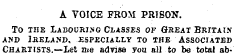
A VOICE FROM PRISON . To the Labouring Classes of Great Britain and Ireland , especially to the Associated Chartists , —Let me advise you all to be total abstainers , n < jtoD ] y from all intoxicating liquors , but from tea , coffee , tobacce , and snuff , and all Excisable articles , except paper for letters and newspapers , and the postage for letters and stamps upon newspapers . Lefc no man say it is impossible to do without the use of Excisable articles , for I have now been npwards of two years , and have neither tasted tea , coffee , engar , or snuff , and I pledge myself that I will never eat or drink any Excisable article , until the Charter becomes the law of the land . Let every working man do the same , and they "will not be long before they have the
Charter tae law of the land—let them at the same time commence exclusive dealing . If you will abstain from the shops of the Whigs and Tories , and all places where intoxicating liquors are sold , and support those shopkeepers which are favourable to the Charter , and frequent the well and pump taverns , where the landlady ' s witii one arm , never refuse to draw their wholesome and refreshing beverage , without money and without price , except tbey are unable to draw for Want of some repairs , and the inevitable consequences of your doing so , will be the Charter for Great Britain , the political freedom of Ireland , the Repeal of the Corn Laws , and the obnoxious Poor Law Amendment Act ; and surely , it will be better for us to sacrifice every luxury for a short time , and put an end to the contest ,
than leave our posterity to dragon a miserable existence for years , for as long ss we have aristocrats , millocrats , and money-mongers for law-makers ; the faces of the poor will be kept npon the grindstone . And now , my dear friends and fellow slaves , let me prevail upon you to use liquid as yon receive it from the pump , in preference to the beverages which are made from exciseable articles . You have all the Chartist ; big gnns at liberty , flock round them , and support them with your small arms to the utmost of year power . For O'Connor , BroBterre , and all the rest of the big guns put together cao do nothing without your assistance ; and witb your assistance tb * y can do every thing-. Be firm and temperat * , and yon will be able to carry every thing your own way . Eacourage the corn law repealers to call meetings , and turn them into Chartist meetings , and you will soon rout the enemy and put an end to their agitation- And last of all , I most earnestly implore wants of the
you to assist and relieve the- poor women and children who are victimia&d , by their husbands and others being incarcerated and disabled by the malice and brutal treatment ef the base , bloodthirsty , and cruel Whigs . If every man and woman professing Chartist principles , would only subscribe a single penny each , for the poor helpless victims , it would drive want and misery from their dwellings , and be a means of eheering the hearts and raising the spirits of these poor , distressed women . Sorely their suffiaings are severe enough in being deprived of . their , huabanda , tha partners of all their joys and sorrows , without being oppressed by hunger and nakedness . I again earnestly appeal to your sympathy on behalf of these poor , helpless victims of WJaiggery ; and I hope , nay , I feel confident , that you will nobly respond to my appeal on their behalf . I now bid you farewell for tie present , and I have the honour to style myself a victim of Whig aaiice , bound Cast in iron , brick , stones , and mortal ,
William Brook Hcuse of Correction , NorthaJIetton , March , 21 st , 1842 ,
Untitled Article
THE CASE OF MR . JAMES BRONTERRE
- ¦ ; :. ; vmmx ; v > v . ; . ; . - - ^ ..-- - -: ; TO THE CHARTISTS OF GREAT BRITAIN . BBOTUEB . CHiETlST 8 ,--I am informed , on good authority , that your well-tried friend—the champion of your political and social rights , James Brbnterre OBrien , is , in * few weeks ; about to issue a newapaper , solely davoted to the people's caus » , which paper , to succeed , must of course be supported by the people ; arid it is to impress upon you the necessity of giving the required support that In » w address you . T ^ You are all doubtless well aware , that of tha many talented men whom -we have amongst us , not ene is more feared ,-and consequently more hated , by the factions ^ . -than . in our redoubtable . ¦ » . Schoolmaster / ' He is feared by them , because they know full well the power W ^ l . ^ miDd ^ bis 6 x « t 3 over public opinion ; and hated , in consequence sf the direction which he gives tothatpower . . 6
He has been prosecuted publicly , and persecuted privately , with a virulence unparalleled in the annals of despotism . ^ Tae Iaw-enforced shafts of a tyrannical Government Ji &ve been discharged at him unsparingly ; and the Diuch . more keenly-pointed arrows of class sel-&hness and Mammenist cupidity have been profusely " let fly" against this ' unconquerable philanthropist The form « r-that is , his public prosecutions-Tare known to all ; out tbe latter—private spleen— caa beknown only to those who are acquainted with faia private history . .. ...- ¦ ... - ¦ ¦ ¦ . "'¦ . ' . ¦ . ¦¦• . ¦ . ¦¦ . ¦ ¦ . ¦ . •¦'•• : ;
This man—thia bright star in our political firmament —he who has suffered , has undergone so much for us , has not been—is not properly supported . The Chartists do not seem to appreciate his services ; they seem to forget bis manifold exertions in their behalf ; they toTgettraiabour 9-hr-. tba- PMry 3 / a ^' s ' GiM ^ i < m . - - -ia-: tb 0 Weekly Dispatch , in HeiKerington ' S Twopenny Dispatch , in tlie Destructive , in the London Mercury , and in the National Reformer ; they forget the incalculable service which he has rendered to the cause of Radical Reformby his Translation of Buonarotti ' a History , and by his Life and Cnaracter of Maximilian Robespierre ; or , at least , if they do not forget these things ; they do not manifest the disposition towards him which they ought . .. ¦ - . ¦ , - ' ' .: ¦ . ... ¦ ¦ ¦ . - . . ¦ .: . „ ; .. . - :. ; , . - ¦ . ¦" ..
He has not new in bis possession anything like the funds adequate to the arduous undertaking in which he is about to engage ; and yet no efforts are being madeor comparatively none—to assist him in this emergency Every reflecting man must feel sensible that if O'Brien be not supported , arid that energetically , it will be an irremediable Injury inflicted upon our good cause—the cause of the poor , oppressed , degraded minions . Would it not be an eternal disgrace to us as a party—a party desiring the overthrow of tyran : iy--to have deprived ourselves , by our apathy j of the aid of one who is in himself a phalanx . This backwardness on OUT part operates in a two-fold manner ; it not only drives from among ns an individual of talent ; but the example tends to prevent men of a similar stamp endangering their prospects of success in life by connection with a party who are unwilling to support them in their efforts to secure their counttya . freedomi
The Chartists have done much , they may do more ; " where there is a will there is a way "—"" ways and means" will accomplish wonder ? . Allow me , then , publicly to suggest a " way" by which the" means " may be acquired , to essentially accomplish the end in view , that ia to say ,, the bringing out of a people ' s paper ... ' : ¦/' . " ¦ ¦ . / :.. ¦ ¦ ¦ ¦ . - '¦¦'¦'¦ . ' . ' . - : v .. . ' . - , / V- - ' -.-Let the members of the General Council throughout the country commence at once a simultaneous canvas of the Chartists gemorally for subscribers to the forthcoming paper ; let them exhort all who can to pay a quarter in advance ; 1 st them get two or three conjointly to subscribe , where they are unable to do so individually , and supposing the quarterly subscription to be five shillings , it would amount to but two shillings and sixpence in the one case , and one shilling and eightpence in the other . Let the sums thus advanced be transmitted by the receivers to Mr . O'Brien , receiving in return an acknowledgment for the papers , being sent when issued direct to the subscribers .
By vigorously pushing this plan forward , you would not only guarantee a good circulation to begin with , but you would secure the success of this great undertaking , by enabling your champion to overcome the financial difficulties under which he now labours . And now one word in conclusion , when the paper does come out , you are morally bonnd id justice to the great principles you advocate to see that the combined efforts of open enemies and pretended friends do not in this ease ( aa they bave in many others ) biirk the endeavour of O'Brien to spread sound political knowledge amongst the people . Warlily watch with eagle eye the " agents , " see that they get you the paperi do not be refused , have it ; and you will have gratified the earnest wish of Your friend and fellow labourer in the cause of Democracy , " ¦ ¦ •¦ - Arthur 0 'Neii . i .. Manchester , April 4 th , 1842 .
Untitled Article
THE STONE MASONS ON STRIKE , FEOM THE NEW : HOVSES OF PABLIABIENT , AND KELSON'S MONUMEJiT , LONDON , AND THE W 00 LWICU DOCKYARD , To the Public and the Trades of Great Britain and . Ireland . " Can * ye * believe « your' living is a life , S » stinkingly depending ?"—Measure for Measure , — ¦ . ' . — "If thia be sure , To do ought good never will be our task . But ever to do ill our sole delight "— Paradise Lost . Brethren , —Notwithstanding the privation and want unto which we are unineritedly subjected , an unbroken and decided front is still maintained against that citadel of cruelty and , coiiuptton from which we have so brutally and determinedly been assailed . We , however , amidst all our poverty , are equally determined —under no circumstances will we relinquish a single jot of Our position— " come weal , come woe , " we will struggle with the enemy to the very lost grasp : At the Hcu ^ es of Parliament , as we have before reported , little progress is perceivable . The number now on the funds from these works and the Monument are reduced to eighty . :
As an evidence of the close-driven position of our opponents , we quote tie following from the Sunday Times newspaper of Sunday , the 20 th inst , and by which yea will perceive it has gone the round of the Metropolitan press-.
—«« PH . OGIIE 9 S OF PUBLIC WOBKS . " The two men who have been long employed upon the Nelson monument in Trafalgar-square , have , it is mentioned in the papers , been obliged to suspend their operations in consequence oi an inadequate supply of granite 1 The result is , that this national work does apt proceed with its former rapidity of about an inch of pedestal every three months . " From Woolwich wa have the following : — " March , 1842 . " I have to inform you that there waa a number of the black diamonds' discharged on Saturday night- — the exact number I cannot give . Three smiths , three carpenters , and a number of labourers , were alao diHCharged , Which 18 a Strong proof that we are very fast gaining ground upt > n our opponents . '—Numbers out 37 . ¦ ¦ ¦ ¦• : ¦ ¦ . •• " ' . • . ¦ : ¦ ¦ ¦ , - ¦ " ¦ ; / . ; / - -- ' .
At Plymouth and Dartmoor matters are much the same as last reported—each party using every possible means to defeat tQe other . —Number out at these places 53 . "' . '¦ ¦ : ¦'¦ ¦ ¦ ' , ¦ ¦ ¦ •¦ - ¦ . ¦¦ - ¦ ' ¦ " ' . : , [ - y ¦ ' ¦ : ' ¦ ¦ ' . ¦ From . Penryn our delegate "Writes , •' That Mr . Hoaking , who needs at this time a hundred men to execute his orders , has only ' eighteen ^ -as also that G . & P . have been again unsuccessful in their attempts to induce other quarry-masters and stone-merehants in that locality to furnish them with granite . " - ^ -Number out 5 . : ' - ¦/ .. '" ¦ ¦¦ ¦ . ' ¦ ; ¦ . ¦• ' .... ' . . ; : ' . ; ¦ . ¦ ¦¦ ¦ ¦ .:- : - ¦ ¦ ¦ .: ¦ ¦ '' This is a brief outline of the circumstances under which we are at present placed . Reflect upon them in connexion with our general conduct thus far throngh the trying ordeal , and say nee they worthy % continuance ef that confidence and support almost universally pledged to us at its commencement .
Alluding to the inevitable consequences resulting to a community when from a low rate of wages its produc--ing portions are in " stinkingly depending" and depressed circumstances , M'Culloch has . -.. the following observatioa :- — -: ¦ ¦ . ¦" '¦ ¦ ' ' ' ; ¦' -. ,. ¦ ¦ ¦ ¦ .. ' ¦ .. ¦ ' , " ' : " Nothing can be so signally disadvantageous , so overwhelmingly disastrous to any people , as a permanent depression in the rate of wages , or a decline in the opinions of the labouring class respecting what is necessary for their corofo tible and decent subsistence . No country can be flourishing when the rate of real wages is low , and none can be long depressed where that rale is high . The labourers are the sinews of agriculture , of manufacture , and of commerce ; their numr beraarenot estimated like those of the other classes , by hundreds , by thousands ; or even by hundreds Of thousands , but by millions ! It ia by their labour that our machinery is constructed and kept in motion , and it ia by their industry and ingenuity that we ate
enabled easily to support burdens , that could hardly be supported by any other people ; every thing , then . that may have the slightest tendency to depress their condition , or : to sink itheih In the scale •( society , ought to be particularly guarded against . Those who feed and dothe all the rest , ought themselves tobetoett fed and well deified ; tbey are the foundation of the social pyramid ; and so long as the standard of natantf or necessary wages continues high , this foundation will be solid and secure , for ad long will the labourers be industrious and orderly ; but if tnia standard be pertnanenOy reduced—if ths labourers be once brought to place their dependence on the cheapest food , and to rest satiefled with mere neeessarles , the want of aafiident motives to exertion will infallibly render them idle and dissipated , the spirit of industry by which they are now so eminently distinguished will evapoiate , and with it the morals , the prosperity , and the happiness of Britain / " ¦ ' ¦ : -: - : ~ > - ' \ ,-. ; - \ ¦ ¦ : ; - ' . ¦¦¦¦ - . ¦• ' ¦ ... ; ,.. . ¦ ¦ <
The depression here contemplated la already too mamifest . Intolerant fanaticism and class legislation ( both of which it is broadly asserted are essential to the social order of society ) have made frightful inroads upon the rights and immunities of the industrious
Untitled Article
classes . " But , " says Channing , " were I ; on visiting a strange country , to see the vast majority of the peo ple maimed , crippled , and bereft ol sights and -were I told that social order required tbis mutilation , I Bhould Say , perish thia order . Who would not think bis under * standing , as well as best feelings insulted by hearing this spoken of as the Intention of God . " Not ought we to look with less aversion on a social system which can only be upheld by " crippling" by excessive toil , and starving by inadequate remuneration , the great mass of o * r order . Frem BaAir we quote the following :-- :. .
"In defence of the present social Bvstem , the capitalists and employers , when they-hear of dissatisfaction , tell us that the working class of the united kingdom have little or nothing to complain of—that they live under institutions comparatively free- ^ -that they can either work or let it alone—and that they ' are better fed , and clothed , and educated , than ; even kings ; were in times of old . To render , yet more striking the contrast between the pteEent and the past condition of the producers ,: - old records are ferought forth to show that the working men of former times were bought and sold , like so many horses , along with the estate to which they were attached—that their houses were but assemblages of sticks and stones , with windows destitute of gluss—that they slept upon rushes strewed upon a
damp clay floor , and had " a log of wpod for a pillow —• that they lived upon the coarsest hod , and scarcely tasted flesh a dczsn times in the year—that they had neither books , newspapers , nor knowledge , and had to either work or fight as their masters and owners thought fit ; If all this be true , and the working ciass be now much better off than their predecessors were , it is ho reason why they should not be still better off , and equally aa well off as those who tell them to hold their tongues , and be contended with the position which they nawoecupy . All happiness is comparative ; and it is not in human nature to remain satisfied with any stationt so long as it is cognizmt of a better ; nor will
men submit to be measured by a low standard , so long as there is a higher one in existence . Why should , enormous masses of wealth be in tbe possession of the idle and the ; profligate , when the industrious and the honest are without a penny ? Why should well-fed and weliclothed insignificance roll slothf ully along in its splendid vehicle , in pursuit of new pleasures to tempt its palled appetite , and the toil-worn artisan be compelled to plod to his daily votb . " with half-isiothea teack and hungry belly ? There is no reason given , for there is not one to be found . The immaculate spirit of justice which exists tbroughomt creation , tells men , in accents of eternal truth , that be never instituted these most unjust distinctions amongst them .
" The productive classes of the United Kingdom are weighed to the earth by such a variety and multiplicity of burthens and wrongs , that enumeration and description both fail in bringing into view the sum totaL The ills they suffer are brought home to them through everyseuse ; for sight , hearing , smell ,. taste , and feeling , alike proclaim the wrong , and tell men that remedy is heeded . / - ; . ¦ . . ¦;' . ' , . > ' . ¦ - ¦ : . ¦ . ¦'• ¦ . ¦ . ¦ ¦ . ¦ . ' ' ¦ . . . ¦ . " That remedy is in the hands of the working classes theniselves . The appropriation of their united means iu a manner calculated to Benefit them , instead of placing it in the hands of those who convert it into weapons to scourge them , would prove a panacea for the entire of Uieir miseries . Channing says—" The great obstacles to the improvement of the labouring
classes are in themselves , and may therefore be overcome . They want nothing but the will . Outward difficulty will shrink and vanish before them , just as far as they are bent on progressr—just as far as the great idea of their own improvement shall take possession of their minds , i know ; that many will smile at the suggestion tbat the labourer may be brought to practise thrift and self-denial for the purpose of 1 ecoming a nobler being . But such sceptics , having never experienced the power of a grand thought or geueroua purpose , are n » judges of others . They may be assured , however , that enthusiasm is not wholly a dream , and that it is not WholJy unnatural for lndlvidnals or bodies to get the idea of something higher and more inspiring than their past attainments . "
The subordinate and humiliating station in society we at present occupy can only be tha effect' of our oirn servility—a want of confidence in onraelvea . We have long had the power If we had had the will to improve our condition to a much greater extent than we have experienced , but have been either too indolent or too CareleSB fully to exeicisB it . This apathetic conduct must he abandoned . The mutual dependency of the trades , and the identity of their interests should stimulate them to gather up their energies and consolidate their strength , that an unbroken front may bo presented to the common foe . it is by our own efforts only—by being true and faithful to each other—that out regeneration cau be effected .
•¦ Think not , indeed , the deBpot ' a heart , For you , cku feelr-foi you can patt With what be ne ' er sweat to obtain , Nor e ' er yet felt oppteasion ' s chain ; Nobly then hasten to the call , Onward we stand—baokward we falL " We beg to Babscrito ourselves , Qratefaliy yoara , . TBLE MASOJfS gOCtETT , THOMAS SH 0 RTT , Sec , 8 , Agnes Street , Watetloo-road , Lambeth , March 30 th , 1842 .
Untitled Article
HOUSE OF COMMONS—Monday , April 4 . The House re-assembled this evening after the Easter recese . ' ' ' ¦ ¦¦ ¦ ¦ ¦ " .. ¦ ¦ - ••¦ ¦¦ ¦¦ ¦¦ '" ' . - .. ¦¦ '•¦ - . ¦ Out of consideration for the anxiety of the many persons whose private interests are involved in the Bubject of the forged Exchequer Bills , Sir fi . Peel gave it priority before the othe « business of the day . The House haying accordingly resolved itself into Committee on the bill for appointing a Commission of Inqtdxylnto the cases . ; oif the various holdeia , Sir T . Wilde moved amendments on several sections ; and proposed two additional clauses , one for enabling the ctoim ^ anta to be beard by attorney or counsel , and the other for compelling an early report from the Commfaaloners . . .- - .. ¦ ' ¦ ' ¦ ' - ¦ ' , '¦ . ' •¦' . ' . " ¦ . ¦ ' ¦ ..
The Solicitor-General stated it to be the iatention of the Goyernaient that tho evidence in general should be reperted ; but as there might be particular cases in which the publication of the facts might be inexpedient ; he would ^^ rather not mak& the bill compulsory in this respect . ; He thought there might be much inconvenience and delay in giving a general right : of being heard by counsel . Sir R . In < gus urged the necessity of despatch . Sir R Pbel acceded to the- general principle ot giving publicity ' to . ^ the evidence , but Wished to allow to the Commissioners , as being inen worthy of all confidence ; a discretion both as to this point and as to the circumBtances in which counsel should be allowed .
Lord J , Russell thought that the Commissioners ought to report tbe whole to the Treasury , and that the Treasury , ; and not they oughtto determine what should or should not be published . " He contended for allowing the liberty to be heard by counsel , wherever the claimants , migfait desire it . '•'•'• . '¦ .:. ' The [ Attorney . Generalargued that the multifarious and unlimited character of tha inquisy . ¦ . ¦ would make it extremely inconvenient to allow au absoluta right of being heard by counse ! , / Colonel Si BTHOB . P ¦ wished for a clause to make those high officere responsible by whose negligence thia loss had occurred j and he desired to know something about the remuneration Of the Commission .
Sir B- PfiiEL answered , that it might be better to pustpone this last consideration until it should be seen what was likely to be the weight and duration of the labour ; and he added , vwith reference to some further observations interposed by Lord J . Russ ^ ili that the Treasury would take the responsibility : of determining what should oe published and what withheld . Sir T . WlX . DE observed , thattfaia was nota case in which the geintfiL regard due to tii « interests of iadividuaJa onghS to ft » 'jBiTed by reason of tbe confidence cJaiined tor certain MtvsoaaAoaera . J / the bills had been private Becurities , the holder * , la any actions upon
them , wouldVhave had the benefib of lepvl aid . But these securities being public , and the holders having therefore no remedy by action , all benefit and indulgence ought surely to be enlarged ntb * rth tm mwrowed . There was no such multifariousnesa as the Attorney-General suggested ; the issneB would be simplei enough . How should the Commissioners , sitting as judges , know to what facts they wera to examine ? The delay Which might be caused by some lengthy speeches was not a consideration to be set againBt the subatantial interests of justice ; nor were the ., ordinary rights of parties to be denied them merely because their judges were men of undoubted character . „ ' • . ¦ . - \ ¦ ... < ' .- ¦¦ - of
Sir W . EflLLETTadmitted the general fitness '¦^ bearing counsel on these cases ; but ^ objected to give such a right aa would virtually take the conduct of the inquiry away from the Commissioners , and place it in the hands of any party who might choose to employ counsel before them . ' ¦ .. '¦ . '¦' ¦ ¦ ' ..: ' . •• .. ¦' . ¦ - ¦ ¦' ' . " ¦ . '¦ ¦ - .. ¦''¦;' . ' ' . ¦¦ . ' . ¦" - ¦¦ Sir R . INGLIS was content that the matter should be left to the discretion of the Commissioners . Mr . Wakley thought tnat if there was a clear under ? standing to the effect lntimat « d by tlwi ! 3 olfcitorTereneral , if the admission ; of counsel were to be the general fale , and their exclusion only the exception . Sir T .-WH'de would have substantially gained Wa object without pressing his clause . Mr . C . Bulleb hoped that ipae construction of thia tribunal there wouid be no deviation from the general mode Of conductinz legal inquiries . .
Sir B . Pbbl aaid that if thetemnn needs in all cases be Counsel against tiie Crown , there » u 8 t also In all cases be counsel for the Crown . These Commissioners were not (» decide , Imt only to report . Sir T . WliDE insisted on the injustice of blowing the Commissioner * to admit or exclude what evidence they pleased . Were ^ they \ to select the witnesses for examination ? If there were objectiona against anyparticular claim , how Were they to learn those objections ? Not > hfi hoped , by private commumcatioia ; the only fak way was the open one , the counsel for each claimant stating hia case , and the counsel for the Treasury theirs . If thia inquiry had been left to a Commifctee of the House 6 ? eommonB , would counBel have been excluded ? He ¦ would not be eon *
Untitled Article
tent With a mere understanding on such a subject ; what was fit to be understood was fit to be directed . ¦ ¦ ' 'i&i . GB . ANviiri . E Verwon , tbouga Blmself . - q \ iit « aatisfied with the argumenteagainBt . the clause was sure its rejection would produce so ^ much dissatisfaction among the claivhants ,, that he much wished to see the Government concede the insertion of it Mr . Kejible feared that the clause would but injure those who sought it , by bringing , the Attorney and Solicitor Ganeral before the Commission -with all their weight to pposa each claim Supported by Caunsel .. . - ' : ' . ' . ¦ , < :. " y-: ' ¦" : ¦ V ;; . ¦ ¦" - ¦ ¦ ; r . ¦¦ - , ¦ - Mr . Baring considered that the parties and tae public ought mutually to have their interests protected by the thorough- sifapg of Counsel on both sides , No steps ought to be taken without the presence ofC-unsel for the Crown , and counsel ought therefore to be admitted for the claimant : ...
The Solicitor Geiteral acknowledged that if counsel were heard on one-side , they must be heard on tha ofcher j but he thought the Commissioners Blight beat dct « rmine In each case whether counsel shouia be admitted at all . , ; : . Mr . Hardy observed , that if the . Commissioner * would be obJiged , 98 he thought that in point of decency they would be , to admit counsel in every & < -e , this was a contest about straws , and the beat way would be to accept ; the clanie . . ' Mr . HaweS said , that . , to exclude counsel onsima claims and admit them on . others , would raise . a prejudice against ilie merits of those cases in whioh ifc ehonld be decided that counsel were necessary . Mr . Attwoob snd Mr . Wason eaid a few words each , and the comDiittee divided ,
For the clause ... ... ... ... 77 Agaipst it •' - ; . « . ... ...... 64 , Majority ... ... 13 The remaining clauses having been disposed of , and the chair having been resumed by the Speaker , Sir R . Peel moved that the House should reaolvei itself into Committee of ways and means . This step , necessary in order to the passing of the resolutions on finance and commerce , was opposed by Mr . Blewitt ,, who moved , by way of amendment or . the motion for the Speaker's leaving the chair , a resolution of bis own , pufporting that the House would postpone the fionsideiation of the MifiiBterial : resolution for rawing : a tax upon income nntil they shonld be further informed about tke duties proposed to be reduced . ¦¦'¦ ' ¦; ' . : ' - .- ¦¦ ¦ ¦ " .. ¦ ¦ -. ' - '¦ ¦ ' ¦¦'¦• :
Mr . ShajLmaw Crawford disapproved both the budget of Sir B . Peel and that of the late Ministry , but desired to have it understood that be was not speuking asapartymah . - : Mr . T . Duncombb Baidj a notion bad gone abroad that the tariff was likely to be postponed ; he wished to know whether it had ever crossed the mbd of Sir R . Peel to postpone it ? ; 3 , Sir R . Peel said it had noti except forihe purpose of consideration . The tariff , so re-consideredj would be ready on Monday , and he trusted it would not be
found by the House to require further alteration in any material respect Beyond that short and neceasary period he had never thought of postponing the subject There was a general impression that the sooner the public should definitively know what the financial . and commercial measure was to : / be , the greater would be the advantage to the national interests . He hoped , now that the holydays had given time for the explosion of popular indignation with which he had bc « n threatened , that thero would be no further delay in the preliminary vote on which that measure was to be founded . ' ;* "" - ¦ - . " ¦ ¦ ¦'• "; : ; : ' ; '"¦• ¦ ' ¦ ¦• " .. '• ¦¦ \ ¦¦ . •'¦ ' .
Mr . Ellice thanked Sir R . Peel for his general pro * gress towards commercial remission ; but he did not approve the reduction of duty on timber . He should have preferred a present addition to the duty on Canadian timber ,, which could well haye borne it , with a ; view , when the circumstances of the country mijcht allow , to tako off that duty and tho daty on foreign timbee both together . As it was . he thoogat Sir K . Peel was m : tking a- needless sacriflce of revenue . He had no objection to the general principle of a direct taxation , tut he conld not sanction a tax upon the income of a profession , or of a perhaps declining trade , like that of his own constituents He had , however , too much confidence in the honest intentions of Sir Robert Peel , ¦ to vote against the preliminary reao * lution . ¦ " .. " - ' . ¦¦'' " - '¦ ¦ ¦ ¦ : ¦ . . : ¦ : - ' .- .. •' . ¦ - - ¦;
Mr . T . IJDNCOJIBE explained , and , after a few words from Sir Robert Peel , Mr , Blewitt withdrew his amendment , and the ; House went into committee . The first resolution was passed without a debate . On the second , Mr . M . Gibson said , he saw no reason for hoping that the proposed income tax would be a merely temporary imposition . . This . ' tariff ' would never make up the deficiency . Perhaps there wera further commercial reforms in view ; if BO , he wished tiiey had been brought forward now , while the country gentlemen were yet subservient to the new Government . He knew not , however , why there should not be a property tak permanently superseding all other tees . The people could not pay public taxes , and also taxes for the benefit of particular classes . To the inequality of an intsome tax he ; . wbolly objected . It would lead to evasions and fr » uds , and so to the em « ployment of spies for the counteraction of them . :
Some discussion followed , whether the Chairman in putting the question on the first resolution had given sufficient time for members to rise in opposition to it ; Mr . Rice , who bad wished to speak , having lost his opportunity . . ;; " ,: ; V ¦ ' • ' ¦ . ' ;¦ . ; . ; . ¦' . "• - -: .. . ¦¦ : ¦ ' ¦ : ' : Mr . Rice then said a few words , intimating his disapprobation of the principle of an income-tax . In consequence of some further observations from Mr . Gibson , : v ; ' : } ] : ¦ ¦'¦ : / . . ' : ¦ : y- ' -i " ¦' - . air Robert PBEL explained , tliat though ha adhered to hia opinion in favour of the principle of an Income Tax , and intended to do his best for the purpose of obtaining a vote to that effect , he had never said that he would throw up his measure rather than allow of any alteration in the details of it . He had never stated nor intended any thing so disrespectful to the House . . :: " .
Mr . Wallace : objected to an Income Tax on the ground of the inducement which it would hold out to commercial men to overstate their incomes . He proceeded , in a strain which raised some laughter , to defend himself and his friends front the charge of faction in their midnight ! divisions before the vacation . Mr . CHRrsxjiAS , Who spoke amidst much noise , was understood to support the resolation .-Mr . WAKLEY ' wished to know why a provision was made for the ; farraeira , exempting them from that
ssrutiriy to which all the trading interests were left liable—a provision exempting them from all payment upon the income of any farm rented below £ 300 a year , and limiting their liability on any higher reut to one-haif © fita amount Great reductions in the in » port duties were abont to be made , from which the working people would suffer severely ; for the Right Honourable Gentleman would thus bring vsirious foreign articles into the home market without at all lowering the price of bread ^ to the manufacturers of the same articles here ; v
Mr . Woutley said , the answer to Mr . Wakley ' s question was , that in tne ; case of the farmer there was a test of income , which in the case of the trader was not to ba obtained . But he must say , that the farmer would raiilies submit to any scrutiny than to the heaT ? y tax which thia teat imposed upon him . ¦ -. . . .- .. Sir R . Peel observed , that the opposite opinions expressed by Mr . Wakley and Mr . Woitley were some evidence ; that ministers had ; endeavoured to steer a middle and a fair course . In answer to Mr . Wakley , he referred to a representation which he had that day . received fsom a numerous body of Vfarmera , deairing to be taxed like persona in other lines of business , rather than by the proposed test . ; Among the farroeM , however , as well as through the country in general , he found a strong disposition to make an exertion toy the
maintenance of public credit ; though it was observable that each class remonstrated , a little ; against the particular mode in wnich itself waa taxed . He had never promised , as some " apprehended , . to propose the * e * moyai of this tax at the end of three years ; he had , indeed , framed the present measnre for throe years only , but he had , on its very first introduction , expressed his hope that at the expiration-of flat term It would be continued by Parliament for a couple of yeara longer , by which time he trusted that the benefits of the tariff Would have come into' full operation . He repeated his conviction that much relief would meanwhile be derived to all classes from the greater cheap * . nesa of living ; and : he exhorted the House n ^ fc to diminV 8 h the efficacy of 85 important an instrument A 3 an Income Tax by qualifying it with exemptions .
Lord Joi « J '• RUSSELL' felt the inexpediency of bo qualifying the income-tax ; but he also felt that very inexpediency as a strong argument for not imposing ifc at all- The tariff < && not jpresent a fair arrangement , for it exposed the British workman to the disadvantage of : foreign competition ^ without giving him acorresponding ckeapness of foreign corn . Her thought the farmers too had been rather ili'used hi the > tariff , especially by a Ministry callihg themselves the farmers ' particular friends , when foreign cattle were let in with aftilittle warning . * ih ^ farmers thought they were safely fofiqwing the front rank , when suddenly that front rank turned round and fired in upon them . The present plan % ouia bave been better if its own principles had b&tt carried , into fall envefc ; bat they Were executed only in a partial and imperfect manner .
Thei CiiAiaKAN ieqtiestsd permission , b e fore he pn % the second Ksolution , " to say that in putting the flrsti he had not been aware of the intention of any membat t oaddress tTOchair . . / :. ¦ .. _ ¦ ¦ ' ¦ . ; ' ; . ' - ' ' C . \/ : r ' ^ '"'' Mr . WiLLtA ^ is said a few words ; oiter ¦ which the second and third resolutions were passed , without division , ana the House resumed ; the report was ordered to be received on Thursday , and the House adjourned .
Untitled Article
^ Execution . —Joseph Wilke ? , convicted at tho Stafford assiz ? 3 of the niurder of an old man of-the name of Adams , at Delves \ Bank , Wednesbury , was executed on Saturday in fwht of the Stafford County gapi . Hia associateB , James WilkeS ; , his brother , Thomas Boswell , and George Giles , were acquitted of the murder but conyioted of ^ burglary , The two former ¦ were sentenced to transportftibh for life * and Giles for fifteen years . The fetched youth , admitted that he had struck the old man , but tnthout the slightest imtenti » n of killing him .
Untitled Article
THE NO R TH E R ¥ S ' FrAUV 7
Emmvial H&Avli&Uwt
Emmvial H&avli&uwt
-
-
Citation
-
Northern Star (1837-1852), April 9, 1842, page 7, in the Nineteenth-Century Serials Edition (2008; 2018) ncse.ac.uk/periodicals/ns/issues/vm2-ncseproduct749/page/7/
-